

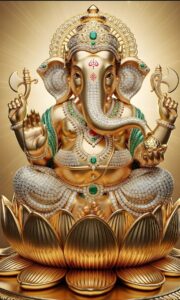
IMAGE CREDITS: https://in.pinterest.com/pin/139119075986563934/
Visit the most unique website on Ucchista Ganapati at Ucchistaganapati.in
( For blogs, videos, sadhana initiations, Pujas, Books, Yantras and Idols of Ucchista Ganapti all at one place)
The Ucchista Ganapati Ashtottara Shatanamavali, commonly known as the Ucchista Ganapati Ashtottaram, is a devotional hymn comprising 108 names that extol the various attributes and virtues of Ucchista Ganapati.
oṃ antasthabhuvanasphītajaṭharāya namo namaḥ oṃ
ॐ अन्तस्थभुवनस्फीतजठराय नमो नमः ॐ
Salutations to the One whose stomach is enlarged by the worlds contained within. The large stomach of Lord gaṇeśa is symbolic of the cosmic egg or brahmāṇḍa containing the entire universe.
Verse 64: The Cosmic Belly of Creation
Sanskrit:
ॐ अन्तस्थभुवनस्फीतजठराय नमो नमः ॐ
Transliteration:
oṃ anta–stha–bhuvana–sphīta–jaṭharāya namo namaḥ oṃ
Word-by-Word Translation
-
oṃ — primordial vibration, source of all existence.
-
anta–stha — “situated within” or “abiding inside”; the indwelling essence.
-
bhuvana — “worlds,” “realms,” or “planes of existence.”
-
sphīta — “vast,” “swollen,” “expanded,” “enlarged.”
-
jaṭharāya — “to the one whose belly/stomach” (jaṭhara) is of such nature.
-
namo namaḥ — repeated salutations, expressing complete surrender.
-
oṃ — concluding resonance, sealing the mantra in unity.
Detailed Commentary
This verse celebrates Gaṇapati as the cosmic container of all existence — the Brahmāṇḍa-puruṣa, the one who holds all worlds within his vast belly (jaṭhara).
1. The Symbol of the Great Belly (Mahodara / Jaṭhara)
-
Gaṇeśa’s large stomach is among his most recognizable features, yet it carries profound metaphysical meaning.
-
It symbolizes the entire universe contained within him — galaxies, stars, worlds, devas, demons, humans, and all dimensions of consciousness.
-
The word sphīta (“expanded”) shows not obesity, but limitless capacity — his ability to hold and harmonize the totality of existence without agitation or imbalance.
2. “Antastha Bhuvana” — The Worlds Within
-
Antastha (“within”) and bhuvana (“worlds”) together point to the inner cosmology — the truth that all outer universes are mirrored in the inner consciousness.
-
In Gaṇapati’s body resides every plane: physical (bhūḥ), subtle (bhuvaḥ), and causal (svaḥ).
-
To meditate on his stomach is to realize that the macrocosm and microcosm are one — the universe outside and the soul within are reflections in his being.
3. The Jaṭhara as the Cosmic Egg (Brahmāṇḍa)
-
The verse equates Gaṇeśa’s belly with the Brahmāṇḍa, the cosmic egg from which all creation arises.
-
Just as an egg contains the potential of life, his belly contains the potential of all manifestation, sustenance, and dissolution.
-
The expansion of the jaṭhara shows the boundless compassion of the Lord, who accommodates all beings — saint or sinner — within his infinite self.
4. The Yogic and Tantric Reading
-
In the body of the sādhaka, the jaṭhara corresponds to the maṇipūra chakra, the fiery center of digestion and transformation.
-
To meditate on Gaṇeśa’s great belly is to awaken the inner fire (jaṭharāgni) that digests not just food, but emotions, karma, and experiences — turning them into wisdom.
-
It represents the perfect balance between containment and expansion, the very secret of tantric equilibrium.
Spiritual Significance
-
The verse invites the devotee to see Gaṇapati as the Cosmic Being, whose body is the universe, whose breath is the wind, whose belly holds every world and being.
-
His large stomach is a symbol of acceptance and balance — he holds joy and sorrow, good and evil, pain and pleasure within himself, without rejection.
-
For the seeker, it is a reminder to develop inner vastness — the capacity to contain life’s opposites without breaking, just as Gaṇapati does.
✨ Verse 64 reveals Ucchiṣṭa Gaṇapati as the cosmic container — the one whose infinite belly is the womb of universes, holding all creation in serene equilibrium.
Discover more from Dr Pallavi Kwatra
Subscribe to get the latest posts sent to your email.