

The Tantric Roots of Lord Jagannatha of Puri
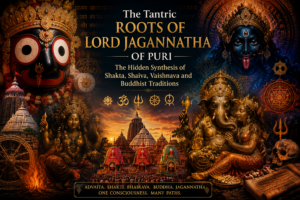
The Hidden Advaita Alchemy of Shaiva, Shakta, Vaishnava and Buddhist Traditions
Among the sacred temples of India, the temple of Lord Jagannatha at Puri stands apart as one of the most mysterious spiritual centers ever created. To the ordinary devotee, Jagannatha appears as Krishna or Vishnu. To the Gaudiya Vaishnava, he is Krishna in ecstatic separation from Radha. To tribal communities, he remains the ancient wooden deity of primordial nature worship.
But beneath all these layers exists another dimension rarely discussed openly — the tantric core of Jagannatha consciousness.
Puri is not merely a Vaishnava pilgrimage center. It is one of the most profound living mandalas of tantric synthesis where Shakta, Shaiva, Buddhist, tribal, Vedantic and Vaishnava currents merged into a single living deity.
Jagannatha is not confined to one religion.
He is the alchemical center where multiple streams of Indian spirituality dissolve into non-dual consciousness.
1. Who is Lord Jagannatha and His Accompanying Deities?
At the center of the Puri temple reside four principal deities:
- Lord Jagannatha
- Balabhadra
- Devi Subhadra
- Sudarshana Chakra
Unlike conventional Hindu deities, Jagannatha is not sculpted according to classical iconographic perfection. His large circular eyes, unfinished limbs and tribal appearance indicate extremely ancient origins that predate classical Brahmanical Hinduism.
The word Jagannatha means:
“Lord of the Universe.”
But esoterically, Jagannatha represents the formless Absolute attempting to take form while remaining beyond form.
The three deities themselves form a profound tantric mandala:
Jagannatha
Represents transcendental consciousness — infinite awareness beyond limitation.
Balabhadra
Represents primal force, Shiva-tattva, kundalini stability and the grounding masculine principle.
Subhadra
Represents Adya Shakti — the primordial womb power between consciousness and force.
In tantric interpretation, the three deities are not separate gods but energetic polarities within the same cosmic field.
Their unusual iconography also resembles ancient tribal and Buddhist sacred forms, suggesting that Jagannatha evolved through spiritual integration rather than religious exclusivity.
2. How Lord Jagannatha Represents the Advaita Alchemy of Shakta, Vedanta, Vaishnavism, Buddhism and Shaiva Traditions
Puri is one of the greatest examples of Indian spiritual syncretism.
Jagannatha absorbs and transcends multiple traditions simultaneously.
Jagannatha as Vaishnava
The outer theological framework identifies Jagannatha with Krishna or Vishnu. The annual Rath Yatra, devotional songs and bhakti traditions reinforce this dimension.
Gaudiya Vaishnavas especially see Jagannatha as Krishna overwhelmed by Radha-bhava — divine ecstatic longing.
Yet this is only one layer.
Jagannatha as Shaiva
Many tantric traditions identify Jagannatha with Bhairava consciousness.
The temple itself contains numerous Shaiva shrines and Bhairava guardians. Ancient Odishan spirituality was deeply Shaiva-tantric before Vaishnavism became dominant.
Balabhadra himself strongly reflects Shaiva symbolism:
- White color
- Serpentine energy
- Force and grounding
- Agricultural plough symbolism linked to kundalini channels
Jagannatha thus contains Shiva consciousness hidden within Vishnu theology.
Jagannatha as Shakta
The most important evidence of Jagannatha’s tantric identity is this:
The food offered to Jagannatha does not become Mahaprasad until it is first offered to Goddess Vimala.
This single ritual changes everything.
In orthodox Vaishnavism, Vishnu is supreme and self-sufficient. But at Puri, the offering attains sacred completion only through the Goddess.
This reveals the temple’s tantric architecture:
- Consciousness requires Shakti.
- Shiva requires Devi.
- Vishnu requires the Mother.
Without Shakti, no divine process is complete.
This is pure Tantra.
Jagannatha as Buddhist
Several scholars and tantric lineages connect Jagannatha with Buddhist influences, especially Vajrayana Buddhism.
Important clues include:
- Large circular eyes resembling certain Buddhist icons
- Non-anthropomorphic sacred forms
- Tribal-Buddhist ritual assimilation
- Emphasis on sacred food distribution
- Processional traditions similar to Buddhist ceremonial movements
Some even interpret the triad of Jagannatha, Balabhadra and Subhadra as transformed representations of Buddhist tantric principles absorbed into Hindu worship.
Odisha historically hosted powerful Vajrayana centers where Buddhist Tantra and Hindu Tantra deeply interacted.
Jagannatha as Advaita
Ultimately, Jagannatha dissolves all boundaries.
He is simultaneously:
- Vishnu
- Bhairava
- Buddha
- Tribal deity
- Shakti-dependent consciousness
- Formless Brahman
This is why Jagannatha cannot be reduced to sectarian theology.
He is Advaita embodied.
The deity teaches that Truth is larger than religious identity.
3. Is Lord Jagannatha Kaalabhairava?
Esoterically, many tantric practitioners interpret Jagannatha as a form of Bhairava consciousness concealed beneath Vaishnava symbolism.
This does not mean Jagannatha is literally identical to the iconographic Kaalabhairava worshipped elsewhere. Rather, it means that the energetic principle governing the kshetra is Bhairavic.
Several reasons support this understanding:
The Kshetra Functions Like a Bhairava Mandala
Puri is not merely devotional.
It is protective, transformative and energetically fierce.
Bhairava governs sacred spaces where:
- ego dissolves
- karmas accelerate
- time collapses
- death transforms into liberation
Puri carries this exact energetic signature.
Jagannatha Transcends Conventional Vishnu Iconography
Unlike classical Vishnu:
- Jagannatha has fierce, unblinking eyes
- His form is incomplete
- His energy is primal and overwhelming
This resembles tantric deity structures more than orthodox Vaishnava aesthetics.
The Cremation Ground Connection
Tantric traditions surrounding Puri historically included:
- cremation ground sadhanas
- Kaula rituals
- Bhairava worship
- Yogini traditions
This strongly links the kshetra to Bhairava-tantric currents.
Bhairava Hidden Inside Vishnu
Tantra repeatedly hides fierce consciousness beneath benign forms.
Jagannatha appears compassionate externally while internally representing annihilating transcendence — a hallmark of Bhairava.
Thus many tantric adepts understand Jagannatha as:
- Vishnu externally
- Bhairava internally
- Absolute consciousness ultimately
4. Who is the Shakti of Lord Jagannatha?
The primary Shakti of Jagannatha is Goddess Vimala Devi.
Her temple exists within the Jagannatha temple complex itself and is one of the most spiritually significant tantric centers in India.
In many tantric understandings:
Jagannatha without Vimala is incomplete consciousness.
Vimala is:
- the activating force
- the consuming power
- the womb of transformation
- the hidden Mahavidya current within Puri
The offering to Jagannatha becomes spiritually complete only after reaching Vimala Devi.
This reveals a core tantric principle:
Shakti legitimizes manifestation.
Without Devi:
- no mantra fructifies
- no deity awakens
- no consciousness expresses itself
Many practitioners also associate Vimala with:
- Durga
- Tara
- Bhuvaneshwari
- Kamakhya currents
- Sri Vidya dimensions
She is not merely a secondary goddess beside Jagannatha.
She is the living tantric heart of the kshetra.
5. What Tantric Practices Are Still Practiced in Puri?
Despite increasing mainstream presentation, numerous tantric traditions continue to survive in subtle forms within Puri.
Vimala Devi Worship
Night rituals and specific festival observances retain strong Shakta-tantric elements.
Animal sacrifice historically occurred in relation to Devi worship within the kshetra during certain periods and festivals.
Mahaprasad as Tantric Sacrament
The famous Mahaprasad is not merely blessed food.
In tantra, sacred food carries transmitted consciousness.
Consumption becomes:
- energetic absorption
- karmic purification
- transmission of deity-force
The communal eating traditions at Puri dissolve caste distinctions in ways strongly aligned with Kaula Tantra.
Nava Kalevara Ritual
The periodic replacement of the wooden deities through secret rituals remains one of the most esoteric traditions in India.
The transfer of the mysterious Brahma Padartha from old deity to new deity occurs under extreme secrecy and resembles tantric transference rites.
Yantra and Mantra Traditions
Many temple rituals continue to use:
- bija mantras
- tantric nyasas
- geometric ritual structures
- esoteric consecration procedures
Though hidden from public view, these traditions never disappeared.
Kaula and Bhairava Currents
Odisha historically hosted:
- Yogini cults
- Bhairava worship
- Kaula lineages
- Vajrayana siddha traditions
Their influence still permeates the subtle atmosphere of Puri.
6. Why is Ucchista Ganapati a Part of the Jagannatha Tradition?
This is among the most hidden dimensions of the Jagannatha kshetra.
Ucchista Ganapati is not the sanitized household Ganesha familiar to popular worship.
He is:
- the lord of liminality
- guardian of forbidden wisdom
- remover of dualistic impurity concepts
- patron of tantric initiation and mantra siddhi
The presence of Ucchista Ganapati within Jagannatha-related tantric streams reveals the temple’s non-dual tantric foundation.
Why Ucchista Ganapati Matters Here
Tantra seeks transcendence beyond conditioned purity structures.
Ucchista means:
- remainder
- residue
- sacred leftover
- transformed impurity
Jagannatha Mahaprasad itself carries this symbolism.
Food sanctified through divine contact transcends social purity laws.
This is deeply aligned with Ucchista Ganapati consciousness.
The Kaula Connection
Ucchista Ganapati is especially revered in Kaula Tantra where:
- sacred consumption
- mantra activation
- Shakti transmission
- non-dual realization
form central practices.
Puri historically functioned as a major Kaula center.
Thus Ucchista Ganapati’s presence is neither accidental nor peripheral.
He protects the esoteric doorway of the kshetra.
7. What is Lord Jagannatha’s Connection to Maa Tara?
The connection between Jagannatha and Maa Tara emerges through the shared tantric matrix of Odisha, Bengal and Vajrayana traditions.
Tara and the Buddhist-Tantric Stream
Maa Tara became central within:
- Vajrayana Buddhism
- Kaula Tantra
- Mahavidya traditions
Odisha historically acted as a meeting ground for these streams.
Tara as the Dark Compassionate Mother
Jagannatha’s immense circular eyes and enigmatic form resonate with the same cosmic vastness associated with Tara consciousness.
Both embody:
- transcendence beyond orthodoxy
- compassionate ferocity
- liberation through dissolution
- crossing beyond fear
Cremation Ground Symbolism
Tara and Bhairava traditions frequently overlap in cremation-ground tantra.
Puri historically preserved these currents beneath public ritual structures.
Subhadra and the Hidden Feminine Principle
Some esoteric traditions interpret Subhadra as concealing deeper Mahashakti currents related to Tara and Bhuvaneshwari.
She stands between Jagannatha and Balabhadra not merely as a sister figure, but as the central womb power balancing consciousness and force.
The Final Secret of Jagannatha
Jagannatha survives because he cannot be imprisoned within one ideology.
He is:
- tribal and cosmic
- devotional and tantric
- fierce and compassionate
- Buddhist and Hindu
- Vishnu and Bhairava
- form and formlessness
The temple of Puri is not merely a religious institution.
It is a living alchemical field preserving one of humanity’s greatest spiritual syntheses.
To the casual pilgrim, Jagannatha is God.
To the tantric adept, Jagannatha is the doorway where all opposites dissolve into the Absolute.
And perhaps that is why his eyes never blink.
Because consciousness itself never sleeps.
Discover more from Dr Pallavi Kwatra
Subscribe to get the latest posts sent to your email.
Pure Consciousness !! !