

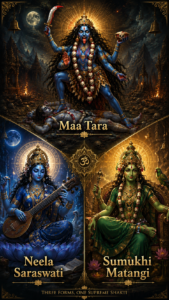
Beyond the Mahāvidyās: The Esoteric Relationship Between Maa Tārā, Nīla Sarasvatī, Sumukhī Mātangī, Ucchiṣṭa Gaṇapati and Mā Kāmākhyā
Many seekers encounter Maa Tārā, Nīla Sarasvatī and Sumukhī Mātangī as independent deities belonging to the Mahāvidyā tradition. While this understanding is not incorrect, it remains incomplete.
Within authentic Kaula and Vāmācāra traditions, these forms are understood as three movements of one uninterrupted current of Śakti—a current that also nourishes the sādhana of Ucchiṣṭa Gaṇapati and culminates in the boundless consciousness of Mā Kāmākhyā.
The connection between these deities is not merely symbolic. It is energetic, philosophical and experiential.
To understand this relationship is to understand why many accomplished Tantric masters naturally revere all of them, even when their primary iṣṭa-devatā appears to be only one.
The Journey from Sound to Silence—and Back Again
Creation begins with vibration.
Before there is form, there is sound.
Before sound becomes audible, it exists as subtle consciousness.
The Tantras describe four progressive states of speech:
- Parā Vāk – the unmanifest, supreme sound resting in pure consciousness.
- Paśyantī Vāk – sound as vision or subtle ideation.
- Madhyamā Vāk – sound taking mental form.
- Vaikharī Vāk – articulated speech expressed through the mouth.
These are not merely linguistic concepts. They describe how consciousness descends into manifestation.
Likewise, spiritual practice reverses this movement. The sādhaka begins with spoken mantra and gradually returns to the silent source from which all mantra arises.
This is where the relationship between these goddesses becomes extraordinarily profound.
Maa Tārā: The Primordial Sound That Liberates
Tārā is often called the Mother of the Pranava.
She represents the compassionate vibration that carries consciousness beyond limitation.
In many Tantric traditions, Tārā is not simply associated with speech—She is the liberating resonance hidden within every mantra.
Every authentic mantra is ultimately intended to dissolve individuality.
Tārā is that dissolving force.
When a sādhaka chants with genuine absorption, it is Tārā who gradually removes the distance between the chanter, the mantra and the deity.
She is therefore the bridge between sound and transcendence.
Nīla Sarasvatī: The Secret Intelligence Hidden Within Mantra
Every mantra possesses three dimensions.
Its audible sound.
Its energetic frequency.
Its conscious intelligence.
Nīla Sarasvatī governs this third dimension.
She is not merely the Goddess of learning.
She is the awakened awareness hidden inside sacred sound.
Without Her grace, mantra remains repetition.
With Her grace, mantra becomes revelation.
This explains why accomplished Tantric practitioners often speak very little.
Their understanding no longer comes from intellectual analysis.
It arises directly from awakened consciousness.
Nīla Sarasvatī transforms knowledge into direct knowing.
Sumukhī Mātangī: When Consciousness Begins Speaking Through the Sādhaka
One of the great mysteries of Tantra is that enlightenment is not the end of expression.
It is the beginning of pure expression.
Sumukhī Mātangī governs this stage.
She refines every instrument through which consciousness communicates.
Speech.
Music.
Writing.
Teaching.
Healing.
Art.
Leadership.
Silence itself.
She is not concerned with eloquence alone.
She transforms the individual into a transparent instrument of Divine Will.
The greatest teachers rarely speak from memory.
They speak from presence.
That spontaneous flow belongs to Mātangī.
The Shared Principle of Ucchiṣṭa
Perhaps no concept is more misunderstood than Ucchiṣṭa.
It is often translated superficially as “leftover” or “ritually impure.”
Tantrically, neither translation captures its essence.
Ucchiṣṭa refers to that state in which the ordinary distinctions created by the conditioned mind begin to dissolve.
It is the transcendence of duality—not the rejection of purity, but the realization that the Divine is not confined by human notions of pure and impure.
Ucchiṣṭa Gaṇapati embodies this transcendence.
Sumukhī Mātangī also dwells within this same current.
Both invite the practitioner to move beyond rigid mental conditioning and discover the sacred presence permeating all aspects of existence.
This is why these two deities are so intimately connected within several Tantric traditions.
Their teachings dismantle limitation rather than reinforce it.
Why Ucchiṣṭa Gaṇapati and Sumukhī Mātangī Are Often Worshipped Together
The relationship between Ucchiṣṭa Gaṇapati and Sumukhī Mātangī is one of the most elegant expressions of Śiva-Śakti harmony within Tantra.
Ucchiṣṭa Gaṇapati represents awakened consciousness that has transcended limitation.
Sumukhī Mātangī is the expressive power of that awakened consciousness.
One is pure awareness.
The other is its living vibration.
One is the silent knower.
The other is the speech of wisdom.
Together they reveal that realization and expression cannot truly be separated.
Kāmākhyā: The Infinite Womb from Which These Currents Arise
Mā Kāmākhyā is not simply another goddess among many.
She is Mahāśakti in Her primordial creative fullness.
She is the cosmic Yoni—the source from which all energies, all Mahāvidyās, all mantras and all worlds emerge.
Tārā is one current of that infinite ocean.
Nīla Sarasvatī is another.
Mātangī is another.
Ucchiṣṭa Gaṇapati Himself derives His dynamic power through Her Śakti.
To worship Kāmākhyā deeply is therefore to enter the living matrix from which all these divine manifestations continuously arise.
The Shared Kaula Principle
Authentic Kaula philosophy does not divide existence into sacred and ordinary.
Everything is Śakti.
Everything is potentially a gateway.
Everything can become sādhana.
This is the common teaching of:
• Maa Tārā.
• Nīla Sarasvatī.
• Sumukhī Mātangī.
• Ucchiṣṭa Gaṇapati.
• Mā Kāmākhyā.
Each removes one layer of conditioning that prevents the seeker from recognising the Divine everywhere.
The purpose is not ritual rebellion.
It is radical spiritual integration.
The Inner Evolution of a Tantric Sādhaka
If we observe the subtle psychology of spiritual growth, these deities illuminate successive stages of inner evolution.
First, fear must dissolve.
This is the grace of Maa Tārā.
Then ignorance must dissolve.
This is the wisdom of Nīla Sarasvatī.
Then self-consciousness must dissolve.
This is the freedom bestowed by Sumukhī Mātangī.
Then duality itself must dissolve.
This is the revelation of Ucchiṣṭa Gaṇapati.
Finally, the seeker recognises that every stage, every deity and every experience has always arisen within the infinite womb of Mahāśakti.
This is Kāmākhyā.
The journey begins with worship.
It matures into realization.
It culminates in identity with the Divine Consciousness that was never separate from the seeker.
One Śakti, Many Doorways
The Tantric scriptures present many deities not to fragment the Divine, but to reveal Its infinite richness. Maa Tārā, Nīla Sarasvatī and Sumukhī Mātangī are not isolated powers moving in different directions. They are complementary currents of one living Śakti that guide the aspirant through protection, awakening and expression.
For the Ucchiṣṭa Gaṇapati sādhaka, these currents remove fear, awaken mantra-caitanya and refine the ability to become a vessel of divine expression. For the Kāmākhyā sādhaka, they reveal the unfolding of Mahāśakti from Her own primordial womb into liberating wisdom and back into embodied realization.
Ultimately, Tantra is not about accumulating more deities to worship. It is about recognising the one Consciousness shining through every form. When these five great manifestations are contemplated together—Mā Kāmākhyā, Maa Tārā, Nīla Sarasvatī, Sumukhī Mātangī and Ucchiṣṭa Gaṇapati—they reveal a complete mandala of transformation: the Divine Mother calls the seeker, protects the journey, awakens inner knowledge, dissolves duality and finally speaks through the awakened soul as Her own living presence.
May every mantra lead inward. May every form reveal the Formless. May every step of sādhana become an expression of the One Śakti who alone appears as Guru, Devatā, Mantra and Self.
Discover more from Dr Pallavi Kwatra
Subscribe to get the latest posts sent to your email.
Thank you Pallaviji for your elucidation of these aspects of the deities.., very helpful everyday language creates clarity and a sense of peace with understanding .., Jai Maa🌺🙏🕉️