

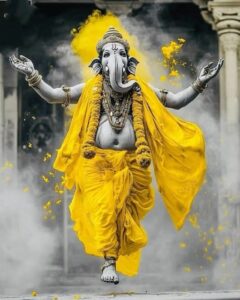
Salutations to the One who has the sky, earth and a tortoise as a seat/pedestal.
The nāmā also means that he’s boundless and spans the space, vacuum and all material worlds, which serve as HIS pedestal.
Word-by-Word Breakdown:
-
oṃ – The sacred primordial syllable; a universal invocation of divinity.
-
ananta (अनन्त) – Infinite, endless, eternal; also refers to Ananta-Śeṣa, the cosmic serpent associated with boundlessness.
-
pṛthivī (पृथिवी) – The Earth; physical, material plane.
-
kūrma (कूर्म) – Tortoise; specifically Kurma, the second incarnation (avatāra) of Lord Viṣṇu, who supports the world during cosmic upheaval.
-
pīṭha (पीठ) – Seat, pedestal, base.
-
aṅga (अङ्ग) – Limb, body part, portion.
-
-āya – Dative suffix meaning “to” or “unto” (indicates the object of salutation).
-
namo namaḥ – Salutations again and again.
-
oṃ – (Repetition reinforces sanctity and closure)
Combined Translation:
“Salutations again and again to the One whose throne or seat is formed by the infinite (space), the Earth, and the tortoise.”
Summary & Commentary:
This nāma paints a powerful cosmic image of Ucchiṣṭa Gaṇapati’s pedestal being made up of:
-
Ananta – representing infinity or the sky/space (ākāśa), perhaps alluding to limitless consciousness.
-
Pṛthivī – the earth, symbolizing the material plane and grounded reality.
-
Kūrma – the tortoise, which traditionally symbolizes stability and support (as in Hindu cosmology, where the tortoise supports the world).
Thus, Gaṇapati is visualized as being seated upon a cosmic throne, composed of eternity, the physical world, and foundational divine support. It places him beyond the limitations of time, space, and form, while also rooted in the very structures of the universe.
This imagery connects him deeply to Tantric philosophy, where the Deity rests upon a symbolic pedestal (pīṭha) made of divine elements or principles. It also subtly references the kundalini chakra system, where the Muladhara (root) chakra is symbolically supported by the tortoise (kūrma) and associated with Ganesha.
Discover more from Dr Pallavi Kwatra
Subscribe to get the latest posts sent to your email.
Madam I want to learn Ucchistaganapati Sadhana please show me a root on this way
Thank you 🙏