

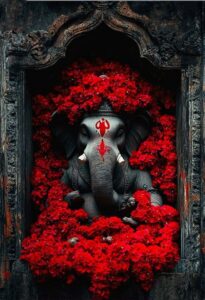
oṃ jayādinavapīṭhaśrīmaṇḍitāya namo namaḥ oṃ
ॐ जयादिनवपीठश्रीमण्डिताय नमो नमः ॐ
Salutations to the One whose pleased with the wonderfully adorned pedestal of HIS pīṭha devatās.
The reference to jayā, an avaraṇa devatā of Lord viṣṇu equates Lord gaṇeśa with Lord viṣṇu, as one and the same.
Another meaning to derive is victory (jayā) in the mantra japa of Lord gaṇeśa, is obtained with the worship of HIS pīṭha devatās and āvaraṇa devatās.
🔸 Word-by-Word Translation:
-
oṃ – The primordial sound; divine invocation of the Absolute.
-
jayā (जया) – Victory; also refers to Jaya, a deity or śakti, and in this context, one of the pīṭha devatās or āvaraṇa śaktis (protective/encircling goddesses).
-
ādi (आदि) – “and others”, “beginning with”; signifies the start of a series.
-
nava (नव) – Nine; refers to nine pīṭhas (seats or energy centers/mandalas) or nine śaktis/devatās.
-
pīṭha (पीठ) – Pedestal, throne, sacred seat; also symbolic of energy centers or mandalas of deities in Tantra.
-
śrī (श्री) – Auspiciousness, beauty, prosperity, splendor, divine grace.
-
maṇḍita (मण्डित) – Adorned, decorated, embellished.
-
-āya – Dative suffix; “to the one who is…”
-
namo namaḥ – Salutations again and again.
-
oṃ – Sacred syllable to seal the verse.
🔸 Combined Translation:
“Salutations again and again to the One who is adorned with the divine splendor of the nine pīṭhas, beginning with Jayā.”
🔸 Commentary:
🔹 1. The Nine Pīṭhas and Jayā:
-
Jayā is named first among the Navapīṭha (Nine Pedestals), which are composed of deities, śaktis, or mandalas surrounding the main deity — in this case, Ucchiṣṭa Gaṇapati.
-
These pīṭhas are not just physical seats but energetic structures within a Tantric maṇḍala. Each one houses a specific śakti or devatā, making up the spiritual architecture of worship.
🔹 2. Link to Āvaraṇa Devatās & Viṣṇu:
-
The name Jayā is also seen among āvaraṇa devatās in Viṣṇu Tantra traditions, suggesting cross-lineage resonance and reinforcing the idea that Gaṇeśa and Viṣṇu are ultimately one — different expressions of the Supreme Consciousness.
-
This kind of symbolism is very common in Tantra, where deities transcend sectarian boundaries and become archetypal energies.
🔹 3. The Mantra Japa Insight:
-
Worship of Gaṇapati’s pīṭha devatās is considered essential to fully awaken his power during mantra japa.
-
The inclusion of “Jayā” as the first reflects the importance of invoking victory in all spiritual endeavors — especially in mantra japa, which is seen as a battle against inner obstacles.
-
Thus, “Jayā” becomes both a goddess and a blessing: the very act of chanting brings victory through the grace of these devatās.
🔸 Esoteric Understanding:
-
This verse hints at a layered structure of the Divine, where Gaṇapati doesn’t act alone but is enthroned on and empowered by his śaktis — much like Śiva and Śakti are incomplete without one another.
-
The navapīṭha are a map of subtle energies, inner sanctums, or even layers of consciousness, leading to the realization of Gaṇapati as Brahman.
Discover more from Dr Pallavi Kwatra
Subscribe to get the latest posts sent to your email.