

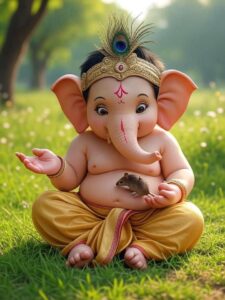
IMAGE CREDITS: https://in.pinterest.com/pin/1126603663091262286/
Visit the most unique website on Ucchista Ganapati at Ucchistaganapati.in
( For blogs, videos, sadhana initiations, Pujas, Books, Yantras and Idols of Ucchista Ganapti all at one place)
The Ucchista Ganapati Ashtottara Shatanamavali, commonly known as the Ucchista Ganapati Ashtottaram, is a devotional hymn comprising 108 names that extol the various attributes and virtues of Ucchista Ganapati.
oṃ kaṇṭhīravamayūrākhuvāhanāya namo namaḥ oṃ
ॐ कण्ठीरवमयूराखुवाहनाय नमो नमः ॐ
Salutations to the One, who has a lion, peacock and a rat as vehicles. Lion is a vehicle for śrī durgā and the peacock of śrī skandā, HIS brother. The rat is the most powerful mūṣikāsura humbled by Lord gaṇeśa.
The vehicles signify the ability to demonstrate ferocity, agility and navigation to any corner or space. Lord gaṇeśa is everywhere and can assist when called upon sincerely by HIS devotees. Worshipping HIM is the same as worshipping śrī durgā and śrī skandā.
Verse 60: Vehicles of Ferocity, Agility & Subtlety
Sanskrit:
ॐ कण्ठीरवमयूराखुवाहनाय नमो नमः ॐ
Transliteration:
oṃ kaṇṭhīrava–mayūra–ākhu–vāhanāya namo namaḥ oṃ
Word-by-Word Translation
- oṃ — the primordial sound, the absolute reality, seed of all mantras.
- kaṇṭhīrava — lion; symbol of ferocity, majesty, and fearless power.
- mayūra — peacock; emblem of beauty, agility, and the destroyer of poisonous influences.
- ākhu — mouse/rat (here mūṣika); represents the asura once humbled by Gaṇeśa and made into his vāhana, also symbol of subtlety and capacity to penetrate unseen spaces.
- vāhanāya — “to the One who has these as his vehicles.”
- namo namaḥ — repeated prostrations, salutation with surrender.
- oṃ — closure, sealing the mantra in sacred vibration.
Detailed Commentary
This verse reveals the vastness of Gaṇapati’s power through the very diversity of his vāhanas (vehicles). Ordinarily, deities are shown with a single vāhana, but here Gaṇapati is acknowledged as carrying multiple symbolic strengths at once:
- Lion (Kaṇṭhīrava)
- The lion is traditionally associated with Śrī Durgā, his mother. By adopting this vāhana, Gaṇapati becomes inseparable from her śakti.
- Symbolically, the lion roars with authority, clearing away fear and cowardice. It is the king of beasts, representing mastery over primal instincts.
- Peacock (Mayūra)
- The peacock belongs to Śrī Skanda (Kārttikeya), Gaṇeśa’s brother. By including the mayūra, Gaṇapati shows his unity with his sibling deity.
- The peacock devours snakes, making it a destroyer of poisons — both literal and metaphorical (toxicity, envy, illusion).
- Its agility and grace remind the devotee that the path of dharma can be both beautiful and victorious.
- Rat/Mouse (Ākhu)
- The rat is the most paradoxical vāhana: tiny, quick, and able to enter the smallest of crevices.
- Traditionally, this was Mūṣikāsura, the demon subdued and transformed by Gaṇeśa. Instead of annihilation, Gaṇeśa turns arrogance into service.
- The rat symbolizes the penetrative capacity of mind and mantra — to reach the subtlest recesses where no other force can enter.
Spiritual Significance
- These vāhanas together represent completeness:
- Ferocity (lion),
- Agility and poison-destruction (peacock),
- Subtle penetration and humble service (rat).
- For the sādhaka, the verse is a reminder that invoking Gaṇapati is not only calling upon the remover of obstacles, but also upon the combined forces of Śrī Durgā and Śrī Skanda. To worship him is to align with the full strength of divine family — śakti, valor, and wisdom.
- On a yogic level, the vehicles parallel three movements of energy within the practitioner:
- Lion — the fierce surge of kuṇḍalinī śakti breaking limitations.
- Peacock — the refined circulation of prāṇa neutralizing toxins.
- Rat — the subtle awareness (citta) that can reach hidden corners of consciousness.
Thus, the verse affirms that Gaṇapati is not confined by a single mode of being. He is the multidimensional guide, accessible in ferocity, in grace, and in subtlety — wherever the devotee calls him.
Discover more from Dr Pallavi Kwatra
Subscribe to get the latest posts sent to your email.