

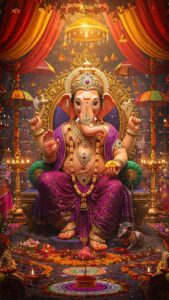
IMAGE CREDITS: https://in.pinterest.com/pin/5770305769213929/
Visit the most unique website on Ucchista Ganapati at Ucchistaganapati.in
( For blogs, videos, sadhana initiations, Pujas, Books, Yantras and Idols of Ucchista Ganapti all at one place)
The Ucchista Ganapati Ashtottara Shatanamavali, commonly known as the Ucchista Ganapati Ashtottaram, is a devotional hymn comprising 108 names that extol the various attributes and virtues of Ucchista Ganapati.
oṃ kumbhodarakaranyastapādābjāya namo namaḥ oṃ
ॐ कुम्भोदरकरन्यस्तपादाब्जाय नमो नमः ॐ
Saluations to the One whose lotus feet are placed on the hands of kumbhodara, the lion faced gaṇa.
Lord śiva places HIS lotus feet on his attendant called kumbhodara, a lion faced gaṇa. Lord śiva has lordship over the gaṇas, a celestial race of beings known for creating obstacles in one’s progress. The gaṇas fulfill the karmic actions destined to the individual jīvās or souls.
This action is symbolic of Lord gaṇeśa in HIS aspect as Lord śiva controlling HIS cravings. To the individuals, it’s symbolic of controlling hunger, desires, lust etc. by focusing on higher pursuits that are the domain of Lord gaṇeśa.
Verse 62: The Lotus Feet on Kumbhodara
Sanskrit:
ॐ कुम्भोदरकरन्यस्तपादाब्जाय नमो नमः ॐ
Transliteration:
oṃ kumbhodara–kara–nyasta–pādābjāya namo namaḥ oṃ
Word-by-Word Translation
-
oṃ — the primordial vibration, seal of sacred invocation.
-
kumbhodara — “pot-bellied one,” here referring to a specific lion-faced gaṇa of Śiva’s retinue.
-
kara–nyasta — “placed upon the hand(s).”
-
pāda–abjāya — “to the one whose lotus feet (pādābja = feet like lotuses) are placed.”
-
namo namaḥ — repeated salutations, surrender.
-
oṃ — closing resonance, unifying mantra.
Detailed Commentary
This verse describes Gaṇeśa’s intimate association with the gaṇas of Lord Śiva, particularly Kumbhodara, a lion-faced attendant. The imagery of Gaṇeśa placing his lotus feet upon the hands of Kumbhodara is loaded with symbolism:
-
The Role of Kumbhodara
-
Among Śiva’s gaṇas, Kumbhodara is known as lion-faced and emblematic of ferocity, hunger, and the raw, consuming instinct.
-
When Gaṇeśa’s lotus feet rest upon his hands, it signals subjugation of the primal urges by divine authority.
-
-
Śiva and the Gaṇas
-
Lord Śiva is the Gaṇapati, the chief of the gaṇas — a celestial host often tasked with placing obstacles before jīvās (souls) to test and refine them.
-
By extension, Gaṇeśa inherits and embodies this lordship, transforming the obstacle-makers into helpers on the path.
-
-
Symbolism of the Lotus Feet
-
The lotus feet are not ordinary — they are śaraṇāgati-pāda, the feet of refuge.
-
For a ferocious gaṇa like Kumbhodara, receiving these feet is a transformation: ferocity is tempered by grace, hunger by contentment, and chaos by order.
-
-
Spiritual Application for the Sādhaka
-
Kumbhodara represents the lower cravings — hunger, lust, greed, and uncontrolled desires.
-
Gaṇeśa placing his feet upon them is symbolic of the sādhaka learning to restrain and sanctify impulses through higher focus.
-
This verse invites practitioners to imagine their own “inner Kumbhodara” bowing beneath the lotus feet of Gaṇeśa — acknowledging cravings yet transforming them into instruments of devotion.
-
Spiritual Significance
-
For Śiva and his gaṇas: It affirms Gaṇeśa’s supremacy, even among the fierce attendants of the Lord of Kailāsa.
-
For the devotee: It is a practical teaching — victory does not come from destroying instincts, but from placing them beneath the feet of wisdom.
-
For yogic practice: This becomes an allegory for sublimating primal energy (kāma, hunger, lust) into oṃkāra and higher pursuits.
✨ Verse 62, therefore, highlights Gaṇeśa as the master of desires and instincts — not by denial, but by placing them under divine guidance, ensuring that even the fiercest urges become servants on the path to liberation.
Discover more from Dr Pallavi Kwatra
Subscribe to get the latest posts sent to your email.