

IMAGE CREDITS: https://in.pinterest.com/pin/18366310975636526/
Visit the most unique website on Ucchista Ganapati at Ucchistaganapati.in
( For blogs, videos, sadhana initiations, Pujas, Books, Yantras and Idols of Ucchista Ganapti all at one place)
The Ucchista Ganapati Ashtottara Shatanamavali, commonly known as the Ucchista Ganapati Ashtottaram, is a devotional hymn comprising 108 names that extol the various attributes and virtues of Ucchista Ganapati.
oṃ kāntākāntatarāṅgasthakarāgrāya namo namaḥ oṃ
ॐ कान्ताकान्ततराङ्गस्थकराग्राय नमो नमः ॐ
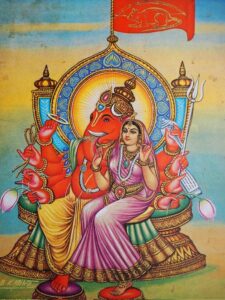
Salutations to the One who places the tip of his trunk on the dazzling body of HIS beloved. This nāmā is symbolic of the śaktipata or the shower of the divine grace on an individual consciousness by the super-consciousness.
Excellent — here’s the full word-by-word translation and detailed commentary for Verse 63 of the Ucchista Ganapati Ashtastotram, written in the same structured, scholarly style as your earlier verses:
Verse 63: The Trunk Touch of Divine Union
Sanskrit:
ॐ कान्ताकान्ततराङ्गस्थकराग्राय नमो नमः ॐ
Transliteration:
oṃ kāntā–kānta–tarāṅga–stha–karāgrāya namo namaḥ oṃ
Word-by-Word Translation
- oṃ — primordial vibration; the sound-body of the Absolute.
- kāntā — the beloved, the divine consort; here symbolic of Śakti, the feminine principle of consciousness.
- kānta — the lover, the divine masculine; here representing Gaṇapati himself as the consciousness principle (Śiva-tattva).
- tarāṅga–stha — “situated upon the waves” or “resting upon the radiance”; from taraṅga meaning wave, vibration, or radiating motion — here indicating the vibrational energy of union between Śiva and Śakti.
- kara–agrāya — “to the one whose trunk (hand-like organ) or hand-tip is placed”; literally, the tip of the hand/trunk that touches or connects.
- namo namaḥ — repeated salutations, complete surrender.
- oṃ — concluding resonance, returning all duality to unity.
Detailed Commentary
This verse portrays one of the most esoteric and tender moments in the Ucchiṣṭa Gaṇapati iconography — the Lord placing the tip of his trunk upon the luminous body of his consort.
1. The Divine Gesture of Union
The trunk of Gaṇapati is not merely a physical feature; it is the instrument of will and transmission — capable of holding, sensing, and bestowing blessings.
- Here, the karāgra (tip of the trunk) gently touches the kāntā (beloved), indicating intimate union of consciousness and energy.
- The act symbolizes śaktipāta — the descent of divine energy or grace from the higher (puruṣa/consciousness) to the lower (prakṛti/individual soul).
- It is a gesture of empowerment and awakening, not of desire or physical affection, but of transference of divine realization.
2. Kāntā and Kānta: Śakti and Śiva in One Body
- Kāntā represents the feminine aspect — beauty, power, attraction, and manifestation.
- Kānta represents the masculine aspect — awareness, stability, and consciousness.
- Their interaction upon the taraṅga, the “wave,” shows the vibration of creation itself, for all existence arises from the pulsation (spanda) of Śiva and Śakti.
- The verse thus becomes a hymn to the cosmic romance — the eternal interplay that births universes, sustains worlds, and reabsorbs them into unity.
3. The Symbolism of the Trunk Touch (Karāgra)
- The trunk in Gaṇapati imagery represents icchā–śakti — the power of divine intention.
- By placing its tip upon the consort, the Lord initiates her into his consciousness, mirroring how a guru’s śaktipāta awakens the disciple’s dormant energy.
- For sādhakas, this signifies the moment of awakening, when the touch of grace stirs the soul from inertia into divine awareness.
Spiritual Significance
This verse is a poetic encapsulation of divine grace in action.
- On the cosmic level, it portrays the sacred union of Śiva (Gaṇapati as consciousness) and Śakti (the beloved, the creative force).
- On the yogic level, it reveals the descent of śaktipāta, when divine awareness touches the seeker and awakens latent power within.
- On the human level, it is an invitation to receive the touch of divine will — allowing the higher self to gently illumine and harmonize one’s emotional and instinctual nature.
The trunk-touch symbolizes that grace is never distant — it descends the moment consciousness and devotion meet in surrender.
✨ Verse 63 reveals Ucchiṣṭa Gaṇapati as the bestower of śaktipāta — the sacred union of Śiva and Śakti, the descent of grace that awakens all beings into divine remembrance.
Discover more from Dr Pallavi Kwatra
Subscribe to get the latest posts sent to your email.