

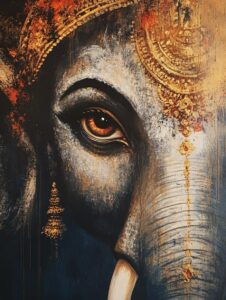
IMAGE CREDITS: https://in.pinterest.com/pin/4606830660087982208/
Visit the most unique website on Ucchista Ganapati at Ucchistaganapati.in
( For blogs, videos, sadhana initiations, Pujas, Books, Yantras and Idols of Ucchista Ganapti all at one place)
The Ucchista Ganapati Ashtottara Shatanamavali, commonly known as the Ucchista Ganapati Ashtottaram, is a devotional hymn comprising 108 names that extol the various attributes and virtues of Ucchista Ganapati.
oṃ ativelamadāraktanayanāya namo namaḥ oṃ
ॐ अतिवेलमदारक्तनयनाय नमो नमः ॐ
Salutations to the One whose eyes are reddened by the excessive discharge due to HIS excitement and rapture.
Brahman the super-consciousness as Lord gaṇeśa, has infinite compassion and longing for the individual consciousness or jīvās or souls, that are essential mirror images of Brahman ITSELF.
Word-by-Word Translation
- oṃ — primordial sound, source of all manifestation
- ati–ānanda — supreme bliss, excessive joy, transcendental ecstasy
- rasa — essence, nectar, emotional and spiritual flavor
- rakta — reddened, colored, infused
- locanāya — to the One whose eyes
- namo namaḥ — repeated salutations, surrender
- oṃ — sealing into unity
Literal meaning:
Salutations to the One whose eyes are reddened by the essence of supreme bliss.
Commentary
This verse moves into territory that is often misunderstood if read superficially. The “reddening of the eyes” is not physical agitation—it is overflow. Overflow of ānanda (bliss), rasa (essence), and above all, compassion.
1. The Red Eyes — Not Anger, but Intensity of Bliss
In many traditions, red eyes suggest anger or intoxication.
Here, it signifies something far subtler:
- intensity of divine experience
- fullness of rasa
- Inability of form to contain infinite feeling
The eyes redden because the experience exceeds containment.
2. Brahman as Longing
Your insight is exact:
Brahman, appearing as Gaṇapati, is not indifferent.
There is:
- longing for the jīva
- compassion toward separation
- urge toward reunion
This is not human emotion—it is cosmic attraction, where the Absolute seeks recognition through the individual.
3. Why “Excess” Matters
The verse uses intensity deliberately.
Not mild compassion.
Not controlled grace.
But excess — ati.
Because:
- the divine does not calculate
- grace is not rationed
- compassion overflows beyond logic
This is why Ucchista Ganapati belongs to the tantric stream—nothing is moderated, everything is total.
4. The Mirror Principle
The jīva is not separate.
It is a reflection of Brahman.
So the compassion is not “for another.”
It is self-recognition trying to happen.
The reddened eyes represent:
- urgency of awakening
- intensity of divine remembrance
- pressure of truth-seeking expression
5. Tantric Implication
In deeper sādhana, this verse points to a state where:
- The practitioner experiences overwhelming inner rasa
- emotions refine into devotion
- devotion dissolves into identity
The boundary between devotee and deity begins to collapse.
Spiritual Significance
- Gaṇapati is not distant—He is deeply invested in the awakening of the jīva
- What appears as delay in life is not neglect—it is ripening
- The divine is not neutral—it is intensely compassionate
✨ Verse 69 reveals Ucchiṣṭa Gaṇapati as the embodiment of overflowing bliss and compassion—whose very eyes reflect the urgency of divine reunion with the soul.
Discover more from Dr Pallavi Kwatra
Subscribe to get the latest posts sent to your email.