

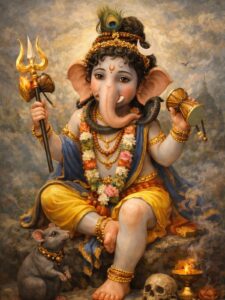
IMAGE CREDITS: https://in.pinterest.com/pin/35114072092157059/
Visit the most unique website on Ucchista Ganapati at Ucchistaganapati.in
( For blogs, videos, sadhana initiations, Pujas, Books, Yantras and Idols of Ucchista Ganapti all at one place)
The Ucchista Ganapati Ashtottara Shatanamavali, commonly known as the Ucchista Ganapati Ashtottaram, is a devotional hymn comprising 108 names that extol the various attributes and virtues of Ucchista Ganapati.
oṃ sarpopavītahārādibhūṣitāya namo namaḥ oṃ
ॐ सर्पोपवीतहारादिभूषिताय नमो नमः ॐ
Salutations to the One whose decorated with a serpent as a sacred thread and adorned with precious gems such as pearls etc. The reference in this nāmā, is to the kuṇḍalini śakti latently present in all beings. kuṇḍalini at the perineum area ascending along the spine is often depicted as a coiled serpent. Sincere devotees can expect the invocation and rise of the kuṇḍalini and ultimate self-realization and absorption into Brahman.
Word-by-Word Translation
- oṃ — primordial vibration, source of all existence
- sarpa — serpent, snake
- upavīta — sacred thread worn across the body
- hāra — necklace, garland
- ādi — and other ornaments
- bhūṣitāya — to the One who is adorned or decorated
- namo namaḥ — repeated salutations and surrender
- oṃ — concluding seal of the mantra
Literal meaning:
Salutations to the One adorned with serpents as sacred thread, necklaces, and ornaments.
Commentary
This verse reveals Ucchiṣṭa Gaṇapati in a distinctly tantric and yogic form, where serpents are not feared but worn as sacred adornments.
1. The Serpent as Sacred Energy
In tantra, the serpent symbolizes:
- kuṇḍalinī śakti
- primal life force
- hidden spiritual power
- awakened consciousness
By wearing serpents upon his body, Gaṇapati demonstrates complete mastery over:
- instinct
- fear
- desire
- latent cosmic energy
The serpent here is no longer dangerous chaos — it has become ornamented awareness.
2. Serpent as the Sacred Thread (Upavīta)
The upavīta traditionally symbolizes:
- spiritual initiation
- responsibility
- entry into sacred knowledge
When Gaṇapati wears a serpent as the sacred thread, it indicates:
- true initiation is energetic, not merely ritualistic
- awakening comes through transformation of life-force
- kuṇḍalinī itself becomes the mark of spiritual authority
This is a radical tantric symbol:
the body itself becomes the yajña, the altar of realization.
3. Serpents as Ornaments (Hārādi Bhūṣita)
The verse expands beyond one serpent.
They appear as:
- garlands
- necklaces
- adornments
This signifies total integration of power.
What ordinary beings fear, suppress, or avoid—
Gaṇapati wears effortlessly.
The serpent ornaments symbolize:
- transcendence of fear of death
- mastery over poison and negativity
- control over subconscious drives
- sovereignty over cyclical existence
4. Connection to Śiva
This imagery strongly parallels Lord Śiva, who also adorns serpents.
Here, Ucchiṣṭa Gaṇapati appears as:
- heir to Śiva’s tantric authority
- lord of hidden energies
- guardian of esoteric wisdom
The serpent ornaments establish him not merely as a remover of obstacles, but as:
the master of transformative force itself.
5. Yogic Interpretation
In yogic symbolism:
- the serpent crossing the torso resembles the ascent of kuṇḍalinī through nāḍīs
- the sacred thread corresponds to awakened prāṇic flow
- the garlands represent stabilized spiritual power
The sādhaka meditating on this form invokes:
- energetic purification
- psychic protection
- awakening of dormant spiritual force
Spiritual Significance
- Fear becomes power when brought under awareness.
- Hidden energy becomes wisdom when disciplined.
- What binds ordinary beings becomes ornament in the realized state.
✨ Verse 71 reveals Ucchiṣṭa Gaṇapati as the Lord of awakened kuṇḍalinī — adorned not by jewels, but by the very forces that govern life, death, and transformation.
Discover more from Dr Pallavi Kwatra
Subscribe to get the latest posts sent to your email.