

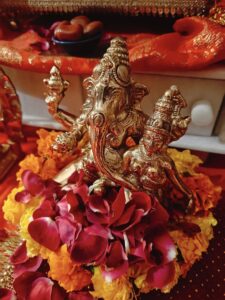
IMAGE CREDITS: Drpallavikwatra.com
Visit the most unique website on Ucchista Ganapati at Ucchistaganapati.in
( For blogs, videos, sadhana initiations, Pujas, Books, Yantras and Idols of Ucchista Ganapti all at one place)
The Ucchista Ganapati Ashtottara Shatanamavali, commonly known as the Ucchista Ganapati Ashtottaram, is a devotional hymn comprising 108 names that extol the various attributes and virtues of Ucchista Ganapati.
oṃ kāntāliṅganasañjātapulakāya namo namaḥ oṃ
ॐ कान्तालिङ्गनसञ्जातपुलकाय नमो नमः ॐ
Salutations to the One who appears ecstatic when in embrace with his beloved.
This nāmā represents the śivaśaktiaikya or the combination of the static and dynamic aspects of the super-consciousness or Brahman. A representation of pure bliss that’s indescribable but can only be experienced when one is liberated.
Word-by-Word Translation
- oṃ — the primordial sound, the source of all manifestation
- kāntā — the beloved, the divine consort, Śakti
- āliṅgana — embrace, union, intimate clasping
- sañjāta — arisen, produced, generated
- pulaka — thrill, horripilation, goosebumps arising from bliss
- āya — to the One who possesses
- namo namaḥ — repeated salutations and prostrations
- oṃ — the concluding seal of the mantra
Literal Meaning:
Salutations to the One whose ecstatic thrill has arisen from the embrace of His beloved.
Commentary
This verse reveals one of the deepest secrets of Tantra: the bliss generated through the union of Śiva and Śakti. Ucchiṣṭa Gaṇapati is rarely depicted as an isolated deity. Instead, He is often shown in intimate union with His Śakti, signifying that consciousness is never separate from its power of manifestation.
1. The Divine Embrace (Āliṅgana)
The embrace of the beloved is not merely romantic imagery.
In Tantra, it symbolizes:
- the union of consciousness and energy
- the merging of subject and object
- the dissolution of duality
- the realization of non-separation
The Divine embraces Its own power, for Śakti is never separate from Śiva.
2. The Meaning of Pulaka
Pulaka refers to the spontaneous goosebumps, thrill, or ecstatic trembling that arises during profound spiritual experiences.
Traditional scriptures describe pulaka as one of the signs of:
- devotional ecstasy (bhāva)
- divine absorption
- spiritual awakening
- overwhelming bliss
The Lord Himself is described as experiencing this bliss, emphasizing that divine love is not cold detachment but living, vibrant awareness.
3. The Cosmic Union
The beloved (kāntā) represents:
- Mahāśakti
- Kundalinī
- Divine Creativity
- Cosmic Mother
Gaṇapati represents:
- Pure Consciousness
- Awareness
- Witnessing Presence
Their embrace is the source of:
- creation
- preservation
- dissolution
- spiritual awakening
All existence emerges from this eternal union.
4. The Yogic Interpretation
Within the practitioner, this verse symbolizes:
- the ascent of Kuṇḍalinī
- the union of Kuṇḍalinī and Śiva
- the awakening of higher consciousness
When these energies unite, profound bliss naturally arises.
The pulaka described here is the inner thrill experienced when spiritual practice matures into direct realization.
5. The Message for the Sādhaka
This verse teaches that:
- true spiritual life is joyful
- realization is accompanied by profound bliss
- divine love is a transformative force
- separation is ultimately an illusion
The embrace of the Divine Beloved is not something external to attain—it is the recognition of the unity already present within.
Spiritual Significance
- Bliss is the natural fragrance of spiritual realization.
- The union of Śiva and Śakti is the source of all creation and awakening.
- Divine love is not emotional attachment but the recognition of non-duality.
✨ Verse 74 reveals Ucchiṣṭa Gaṇapati as the embodiment of divine ecstasy, whose very being thrills with bliss through eternal union with His beloved Śakti.
Discover more from Dr Pallavi Kwatra
Subscribe to get the latest posts sent to your email.