

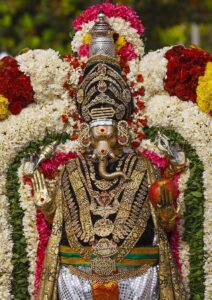
oṃ vāṇīdurgāṃśabhūtārhakalatrāya namo namaḥ oṃ
ॐ वाणीदुर्गांशभूतार्हकलत्राय नमो नमः ॐ
Salutations to the One who has the śakti or power of vāṇī (Sarasvati) and durgā (combination of Pārvati or śakti, lakṣmī and Sarasvati).
The nāmā suggests that the devotees may be bestowed with all types of wealth, knowledge and courage, along with success in all endeavors.
Here is a detailed word-by-word translation and commentary on the mantra:
Mantra:
oṃ vāṇīdurgāṃśabhūtārhakalatrāya namo namaḥ oṃ
ॐ वाणीदुर्गांशभूतार्हकलत्राय नमो नमः ॐ
Word-by-Word Translation:
- oṃ (ॐ) – The primordial sacred syllable; source of all sound and vibration; invokes divine presence.
- vāṇī (वाणी) – “Speech” or “Voice”, here personified as Goddess Sarasvatī, the deity of knowledge, wisdom, and expression.
- durgā (दुर्गा) – Refers to the fierce and protective Goddess Durgā, symbolizing power, courage, and divine strength.
- aṃśa (अंश) – “Portion”, “aspect”, or “ray”; denotes a part or emanation.
- bhūta (भूत) – “Become”, “formed of”, or “constituted by”.
- arha (अर्ह) – “Worthy of”, “deserving”, “fit for”.
- kalatra (कलत्र) – Literally means “wife” or “consort”; in Tantric symbolism, it can also imply the sacred feminine partner, the divine shakti.
- āya (आय) – “To”, “for”; this is part of the dative case ending indicating “to the one who is…”
- namo namaḥ (नमो नमः) – Repeated expression of profound salutations, with humility and devotion.
- oṃ (ॐ) – Closes the mantra, sealing it in sacred vibration.
Full Translation:
“Salutations again and again to the One who is worthy of being the consort, composed of and embodying aspects of Vāṇī (Sarasvatī) and Durgā.”
Commentary & Spiritual Meaning:
This nāma honors Ucchiṣṭa Gaṇapati as:
- The divine consort or partner of śakti, specifically of those shaktis who embody speech (Vāṇī/Sarasvatī) and divine power (Durgā).
- The One who is formed of (bhūta) and deserving of (arha) the combined essences (aṃśa) of Goddess Sarasvatī and Durgā.
- In this light, he becomes the union point of knowledge and power, the Supreme Tantric Lord, complete only with the union of divine feminine energies.
This name emphasizes:
- Tantric union (Śiva–Śakti principle).
- Integration of strength and wisdom.
- Recognition of the divine feminine as essential to the Supreme.
Practice Tip:
When chanting this name during japa or dhyāna, visualize Ucchiṣṭa Gaṇapati seated with his shakti, radiating the white brilliance of Sarasvatī and the fiery red aura of Durgā — symbolizing balanced knowledge and power, inviting you to rest in their sacred embrace of completeness.
Discover more from Dr Pallavi Kwatra
Subscribe to get the latest posts sent to your email.
Namaskar Pallavi ji, can this mantra be practised independently or is it a part of a stotram, which has to be chanted fully.
Namaste Veerendra Ji,
This mantra is one of the verses of the Ucchista Ganapati Ashtastoram hym which has 108 verses. So The whole stotram must be chanted. I am doing a word by word translation of each verse every thursday to break into small parts the whole text and inspire continous learning for the saadhaka. I am also working on translating 1000 names of Ucchista Ganapati Sahasranama in a similiar manner with word by word breakdown and adding commentaries on each of the 1000 namas. thank you. For Upasana, It is advisable to receive deeksha into moolmantra and chant that to start your journey.