Word-by-Word Translation
- oṃ — the primordial vibration; the source and essence of all manifestation
- sāyantana — evening, pertaining to sunset or twilight
- sahasra — thousand; symbolically, innumerable or immeasurable
- aṃśu — ray, beam, shaft of light
- raktāṅga — one whose body (aṅga) is red or suffused with crimson radiance (rakta)
- āya — to the One who possesses this quality
- namo namaḥ — repeated salutations, prostration and surrender
- oṃ — the sacred concluding vibration
Literal Meaning
“Salutations to the One whose body is suffused with the crimson radiance of a thousand rays of the setting sun.”
Commentary
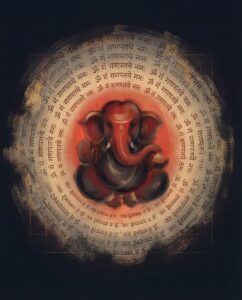
Verse 77 brings us to a magnificent visual form of Ucchiṣṭa Gaṇapati: His entire body glowing crimson with the immense radiance of the evening sun.
The imagery is particularly significant because the verse does not simply compare Him to the sun. It evokes the sāyantana, the sun at the threshold between day and night—a moment when one form of light is beginning to dissolve into another.
This makes the verse deeply connected with transformation, dissolution and the transition of consciousness.
1. Sāyantana — The Mystery of Sunset
The word sāyantana refers to evening or the setting sun.
Sunset is a liminal state.
It is neither fully day nor fully night.
In tantric understanding, such transitional moments can represent a sandhi—a junction where one state dissolves and another emerges.
Thus, Ucchiṣṭa Gaṇapati appearing with the radiance of sunset points toward:
- transition
- transformation
- dissolution of old patterns
- movement from one state of consciousness into another
- the meeting point between manifestation and absorption
The sādhaka is reminded that transformation does not always happen suddenly. Often, consciousness gradually changes colour, just as the sky transforms at sunset.
2. Sahasrāṃśu — A Thousand Rays
Sahasrāṃśu literally means thousand-rayed.
The number thousand here conveys immeasurable radiance rather than merely a numerical quantity.
Every ray represents a movement of divine consciousness into manifestation.
The imagery therefore presents Gaṇapati as a being whose radiance is not localized. His consciousness shines outward in countless directions.
This also creates an interesting resonance with the sahasrāra, the thousand-petalled lotus associated with the highest realization.
The thousand rays can therefore be contemplated as the expansion of consciousness beyond limitation.
3. Rakta — The Crimson Colour of Śakti
The word rakta means red, crimson, or suffused with colour.
Red has an especially important place in tantric symbolism.
It can represent:
- Śakti
- life-force
- desire
- manifestation
- passion
- creative power
- the dynamism of consciousness
Ucchiṣṭa Gaṇapati’s red body therefore presents Him not as an abstract, inactive Absolute, but as Consciousness alive with Śakti.
This is important to the tantric understanding of Gaṇapati: consciousness and its power of manifestation are not separate.
4. Why the Setting Sun?
The choice of the setting sun rather than the midday sun is particularly beautiful.
The midday sun represents maximum external illumination.
The setting sun represents illumination turning inward.
As daylight disappears from the external world, the sādhaka is invited to discover another light—the light of consciousness within.
Thus, the crimson form of Gaṇapati can be contemplated as the transition:
external light → inner light → pure awareness
The sunset therefore becomes a metaphor for the inward journey of sādhana.
5. The Tantric Meaning of the Red Form
Ucchiṣṭa Gaṇapati is frequently associated with powerful red imagery—sindūra, red flowers, red garments and the vibrant energy of Śakti.
Verse 77 continues this visual language.
Here, however, the red is no longer merely an attribute applied to the deity.
His entire body itself has become radiance.
This is a significant progression.
The deity is not wearing Śakti.
He is pervaded by Śakti.
The distinction between the deity and divine energy begins to disappear.
6. The Inner Meaning for the Sādhaka
For the practitioner, this verse can be understood as a meditation on the transformation of one’s own identity.
At the beginning of sādhana, one sees the Divine as something external.
With practice, the presence of the deity begins to permeate one’s:
- thoughts
- emotions
- actions
- desires
- perception
Eventually, the practitioner recognizes that the same consciousness that is worshipped externally is the consciousness within.
The crimson radiance of Gaṇapati becomes a symbol of that realization.
Spiritual Significance
Verse 77 is ultimately about the transformation of consciousness through divine radiance.
The setting sun teaches the sādhaka that endings are not failures. Every dissolution creates the possibility of a new state of awareness.
The thousand rays remind us that divine consciousness is limitless.
The crimson body reveals that this consciousness is not lifeless emptiness—it is dynamic Śakti, alive, creative and intensely present.
✨ Verse 77 reveals Ucchiṣṭa Gaṇapati as the crimson radiance of the setting sun—the luminous presence at the threshold between manifestation and dissolution, guiding the sādhaka from external light toward the light of inner realization.


Namathe Namasthe Namasthe. 🙏
Deep and beautiful explanation which take the Sadhakas to feel the God.