Verse 78 Ucchista Ganapati ashtastotram: The Beautiful Form of the Complete Pranava
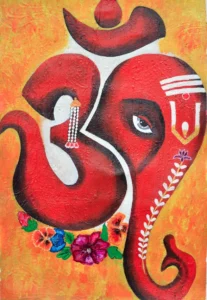
IMAGE CREDITS: https://www.fizdi.com/om-ganesha-prt_7664_54061-canvas-art-print-21in-x-30in/?srsltid=AU7gw4VBhjeyGePHh6KFU-il3FjQv54x2APQqHOYO446DKoGRO04Qhas
Visit the most unique website on Ucchista Ganapati at Ucchistaganapati.in
( For blogs, videos, sadhana initiations, Pujas, Books, Yantras and Idols of Ucchista Ganapti all at one place)
The Ucchista Ganapati Ashtottara Shatanamavali, commonly known as the Ucchista Ganapati Ashtottaram, is a devotional hymn comprising 108 names that extol the various attributes and virtues of Ucchista Ganapati.
oṃ sampūrṇapraṇavākārasundarāya namo namaḥ oṃ
ॐ सम्पूर्णप्रणवाकारसुन्दराय नमो नमः ॐ
Salutations to the One whose wondrous form, represents the praṇava mantra “oṃ” and is the very embodiment of the same.
The praṇava mantra “oṃ” is the ultimate mantra and represents Brahman.
Word-by-Word Translation
- oṃ — the primordial sacred syllable; the Praṇava; the sound-symbol of ultimate reality
- sampūrṇa — complete, whole, perfect, fully integrated
- praṇava — the sacred syllable Oṃ, regarded as the primordial vibration and expression of Brahman
- ākāra — form, shape, appearance, embodiment
- sundara — beautiful, auspicious, lovely, pleasing
- āya — to the One who possesses or embodies this quality
- namo namaḥ — repeated salutations, reverential prostration
- oṃ — the sacred concluding Praṇava
Literal Meaning
“Salutations to the Beautiful One whose complete form is the embodiment of Praṇava, Oṃ.”
Commentary
Verse 78 takes the contemplation of Ucchiṣṭa Gaṇapati from physical form into sound and consciousness.
The preceding verses have progressively described His body, ornaments, radiance, weapons and cosmic attributes. Here, the stotra makes a profound transition: the entire form of Gaṇapati is identified with Praṇava itself.
He is not merely a deity who is invoked through Oṃ.
His very form is understood as Oṃ made visible.
1. What is Praṇava?
Praṇava is one of the traditional names for Oṃ (ॐ).
Oṃ is regarded in the Upaniṣadic and yogic traditions as the primordial sound-symbol of ultimate reality.
The Māṇḍūkya Upaniṣad, in particular, makes Oṃ central to its teaching on consciousness.
The syllable is traditionally analysed through:
- A — waking consciousness (jāgrat)
- U — dream consciousness (svapna)
- M — deep sleep (suṣupti)
- the silence beyond the three sounds — turīya, the fourth, transcendent state
Thus, Praṇava encompasses the entire range of experience and that which transcends experience.
2. Sampūrṇa — Complete and Whole
The word sampūrṇa is crucial.
Gaṇapati is not described as merely associated with Oṃ. He is described as sampūrṇa-praṇavākāra—completely of the form of Praṇava.
This suggests totality.
Nothing is excluded:
- waking
- dreaming
- deep sleep
- transcendence
- manifestation
- dissolution
- sound
- silence
All are contained within the completeness represented by Praṇava.
Therefore, contemplating Ucchiṣṭa Gaṇapati becomes a contemplation of wholeness itself.
3. From Oṃ to Form
There is a beautiful tantric movement in this nāma:
Sound → vibration → form → consciousness
Oṃ is normally experienced as sound or mantra.
Here, the stotra reverses the process and asks us to see the deity itself as embodied mantra.
This is an important principle in tantric practice.
A mantra is not merely a collection of syllables. Through sādhana, the mantra becomes devatā—the living presence of the deity.
Thus:
mantra is devatā, and devatā is mantra.
Ucchiṣṭa Gaṇapati can therefore be contemplated not simply as an image before the practitioner, but as the visible expression of the primordial vibration.
4. The Beauty of Praṇava
The word sundara adds an important dimension.
The verse does not merely say that Gaṇapati has the form of Oṃ. It calls that form beautiful.
This beauty is not merely aesthetic.
It is the beauty of perfect integration.
When consciousness, energy, manifestation and transcendence are understood as one reality, there is no contradiction remaining.
That wholeness itself is saundarya—beauty.
5. Ucchiṣṭa Gaṇapati and Non-Duality
The verse can also be read through the non-dual understanding of consciousness.
The apparent divisions between:
- deity and devotee
- sacred and mundane
- sound and silence
- form and formlessness
- manifestation and transcendence
ultimately arise within consciousness.
Praṇava encompasses these apparent opposites.
Therefore, seeing Ucchiṣṭa Gaṇapati as sampūrṇa Praṇava is to recognize Him as a symbol of the consciousness in which all opposites arise and dissolve.
6. The Sādhaka’s Inner Practice
For the practitioner, this nāma offers a beautiful meditation.
Rather than visualizing Gaṇapati only as an external form, one can contemplate:
“The form I see is Oṃ.
The mantra I repeat is Gaṇapati.
The consciousness hearing the mantra is also Gaṇapati.”
The movement is therefore from:
worship → mantra → meditation → recognition.
Eventually, the distinction between the one who chants, the mantra being chanted, and the deity invoked becomes increasingly subtle.
7. Oṃ as the Complete Field of Consciousness
The final Oṃ in the nāma is particularly significant.
The mantra begins with Oṃ and concludes with Oṃ.
This creates a symbolic enclosure:
Oṃ → Gaṇapati → Oṃ
Everything begins in Praṇava and resolves back into Praṇava.
The deity’s form is therefore not outside the primordial reality represented by Oṃ. He is an expression of it.
Spiritual Significance
Verse 78 marks an important philosophical deepening in the Ucchiṣṭa Gaṇapati Ashtastotram.
The earlier nāmas invite us to contemplate Gaṇapati through His physical form, colours, weapons, ornaments and cosmic attributes. Here, the external form is transcended into mantra and consciousness.
The practitioner is invited to understand that the Divine can be approached through:
- form
- sound
- mantra
- meditation
- pure awareness
And ultimately these are not separate.
✨ Verse 78 reveals Ucchiṣṭa Gaṇapati as the complete and beautiful embodiment of Praṇava—Oṃ itself made manifest as divine form, encompassing every state of consciousness and resolving ultimately into the silence beyond sound.
Discover more from Dr Pallavi Kwatra
Subscribe to get the latest posts sent to your email.