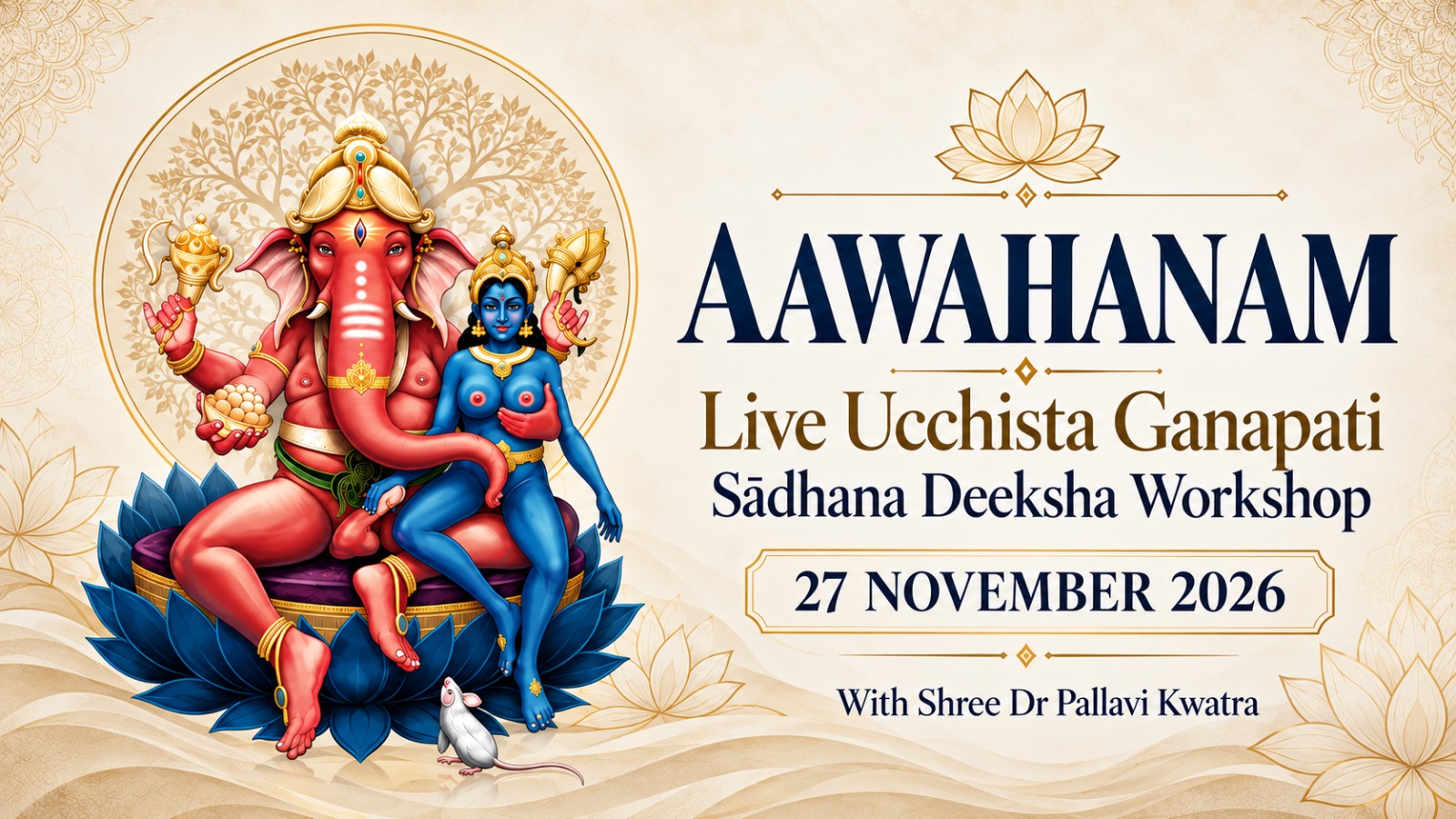
IMAGE CREDITS: Drpallavikwatra
Visit the most unique website on Ucchista Ganapati at Ucchistaganapati.in
( For blogs, videos, sadhana initiations, Pujas, Books, Yantras and Idols of Ucchista Ganapti all at one place)
The Ucchista Ganapati Ashtottara Shatanamavali, commonly known as the Ucchista Ganapati Ashtottaram, is a devotional hymn comprising 108 names that extol the various attributes and virtues of Ucchista Ganapati.
Verse 79: Born from the Sacrificial Fire of Brahmā and the Devas
Sanskrit:
ॐ ब्रह्मादिकृतयज्ञाग्निसम्भूताय नमो नमः ॐ
Transliteration:
oṃ brahmādi-kṛta-yajñāgni-sambhūtāya namo namaḥ oṃ
Meaning:
“Salutations to the One who arose from the sacrificial fire of the yajña performed by Brahmā and the other divine beings.”
Word-by-Word Translation
- oṃ — the primordial vibration; Praṇava; the sacred sound-symbol of ultimate reality
- brahma — Brahmā, the creator deity
- ādi — and others; Brahmā and the other devas
- kṛta — performed, made, undertaken
- yajña — sacrificial offering, sacred ritual, yajña
- agni — fire; particularly the sacred fire of the yajña
- sambhūta — arisen from, born from, manifested from
- āya — to the One who is
- namo namaḥ — repeated salutations, reverential prostration
- oṃ — concluding Praṇava
Literal Meaning
“Salutations to the One who manifested from the sacrificial fire of the yajña performed by Brahmā and the other devas.”
Commentary
This nāma presents Ucchiṣṭa Gaṇapati through the powerful imagery of yajña-agni, the sacred fire of sacrifice.
Fire is not simply an element here. It is the medium through which the visible and invisible worlds communicate. Offerings are placed into the fire, transformed, and offered to the divine.
Gaṇapati emerging from such a fire therefore represents the manifestation of divine consciousness through sacred transformation.
1. Brahmā and the Devas
Brahmādi means Brahmā and the other divine beings.
Brahmā represents the creative principle—the power through which manifestation arises.
The devas represent various cosmic functions and forces.
When the verse says that they perform a yajña and Gaṇapati arises from its fire, the imagery places Gaṇapati within the cosmic process itself.
He is not merely a deity worshipped by the devas.
He manifests within the very sacrificial process through which cosmic order is maintained.
2. Yajña — The Sacred Act of Offering
The fundamental principle of yajña is offering.
Something is surrendered into the sacred fire so that it may be transformed.
At the outer level, this may involve offerings such as:
- clarified butter
- grains
- herbs
- mantras
- other prescribed substances
At the inner level, however, yajña can represent the offering of:
- desires
- attachments
- ego
- thoughts
- actions
- karmic tendencies
The fire transforms what is offered.
Thus, this nāma can be read as a profound teaching on inner alchemy.
3. Agni — The Fire of Transformation
Agni is the transforming principle.
Fire consumes one form and releases another.
In spiritual practice, this becomes a powerful metaphor.
The practitioner offers limitation into the fire of awareness, and through sādhana it is transformed.
Therefore, Gaṇapati arising from yajñāgni can be contemplated as the consciousness that emerges when offering and transformation are complete.
The obstacle itself becomes fuel for awakening.
4. Sambhūta — “Arisen From”
The word sambhūta is especially significant.
It means born from, arisen from, or manifested from.
The verse is therefore giving us a specific image of manifestation.
The deity is revealed through fire.
This does not necessarily mean that Gaṇapati has a literal biological birth from an ordinary fire. Within sacred imagery, the fire represents the concentrated power of mantra, intention, offering and divine will.
Gaṇapati manifests from that convergence.
5. The Tantric Reading
For a sādhaka, the yajña can be understood internally.
The body becomes the altar.
The breath becomes the offering.
The mind becomes the field of sacrifice.
The mantra becomes the fire.
And the limited sense of “I” becomes the ultimate offering.
From this inner yajña emerges a different understanding of Gaṇapati—not merely as an external deity, but as the awakened consciousness revealed when obstruction is consumed.
This is particularly relevant to Ucchiṣṭa Gaṇapati, whose tantric symbolism repeatedly challenges the practitioner to transform rather than merely reject what is considered impure, difficult, or undesirable.
6. Connection with Gaṇapati as Remover of Obstacles
There is a beautiful relationship between yajña and Gaṇapati’s traditional role as Vighneśvara, Lord of obstacles.
An obstacle can be:
- removed,
- transformed,
- or revealed as an opportunity for growth.
The yajña fire provides the third possibility.
Rather than simply destroying an unwanted tendency, the fire transforms it into something usable.
This gives the nāma a deeper message:
What obstructs the sādhaka can become fuel for the sādhana.
7. The Deeper Philosophical Meaning
There is also an important non-dual reading.
Who is performing the yajña?
Who is the fire?
Who is being invoked?
Who ultimately receives the offering?
At the highest level of spiritual understanding, these distinctions begin to dissolve.
The worshipper, the offering, the fire, the mantra and the deity are understood as expressions of one consciousness.
Thus, Gaṇapati arising from the yajñāgni can be contemplated as the Divine revealing itself through the very act of surrender.
Spiritual Significance
Verse 79 teaches that divine manifestation can emerge through sacred offering and transformation.
The external yajña becomes a mirror for the internal yajña of the sādhaka.
Every time we consciously offer an attachment, desire, fear or limitation into the fire of awareness, we create space for a deeper dimension of consciousness to emerge.
Ucchiṣṭa Gaṇapati therefore appears here not simply as the receiver of offerings, but as the very presence that emerges from the perfected act of offering.
✨ Verse 79 reveals Ucchiṣṭa Gaṇapati as the One manifested from the sacred fire of the yajña of Brahmā and the devas—the transformative consciousness that emerges when offering, fire, mantra and divine intention converge.
Discover more from Dr Pallavi Kwatra
Subscribe to get the latest posts sent to your email.