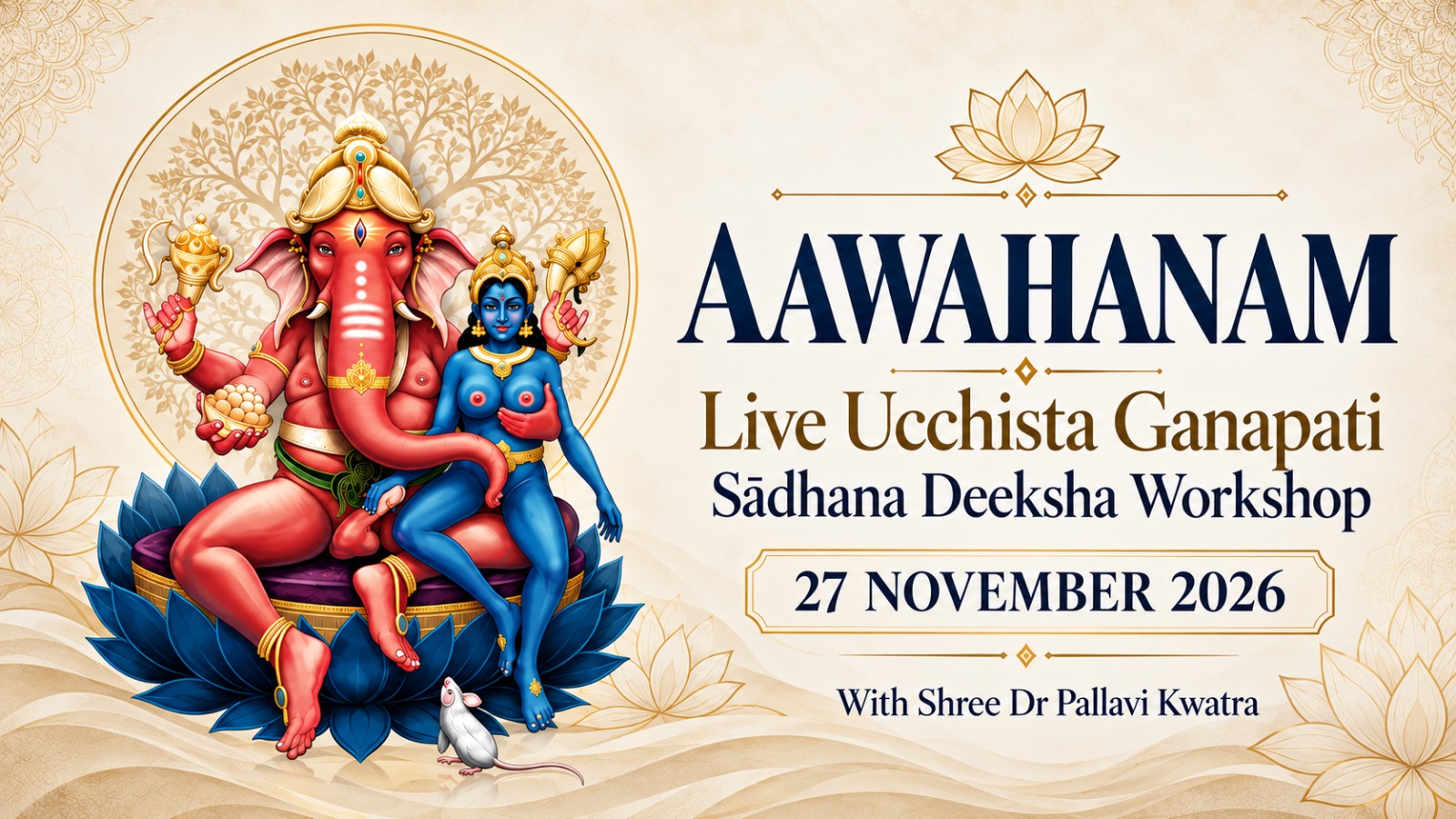
IMAGE CREDITS: https://in.pinterest.com/pin/599752875403394055/
Visit the most unique website on Ucchista Ganapati at Ucchistaganapati.in
( For blogs, videos, sadhana initiations, Pujas, Books, Yantras and Idols of Ucchista Ganapti all at one place)
The Ucchista Ganapati Ashtottara Shatanamavali, commonly known as the Ucchista Ganapati Ashtottaram, is a devotional hymn comprising 108 names that extol the various attributes and virtues of Ucchista Ganapati.
oṃ sarvāmaraprārthanāttavigrahāya namo namaḥ oṃ
ॐ सर्वामरप्रार्थनात्तविग्रहाय नमो नमः ॐ
Salutations to the One who’s worshipped first and also assumes form at the prayer rituals of all gods.
Verse 80: The Form Invoked Through the Prayers of All the Devas
Word-by-Word Translation
-
oṃ — the primordial sacred syllable, Praṇava, representing ultimate reality.
-
sarva — all, every, the entirety.
-
amara — the immortals; the devas or celestial beings.
-
prārthanā — prayer, invocation, supplication or earnest appeal.
-
ātta — assumed, taken up, received or manifested, depending on the compound’s intended construction.
-
vigraha — form, embodiment, manifested appearance.
-
āya — to the One who possesses or embodies this quality.
-
namo namaḥ — repeated salutations, reverence and surrender.
-
oṃ — the sacred concluding syllable.
Literal meaning: Salutations to the One whose form is assumed or manifested in response to the prayers of all the devas.
Textual note: The compound sarvāmaraprārthanāttavigrahāya is interpreted here according to the meaning supplied with the verse. Its precise grammatical segmentation would benefit from comparison with the source text.
Detailed Commentary
Verse 80 reveals Ucchiṣṭa Gaṇapati as a deity whose significance extends beyond the human world. He is invoked not only by individual devotees but also by the devas, the celestial powers who govern different aspects of cosmic existence.
The verse brings together two important dimensions of Gaṇapati’s divinity: His manifestation in response to divine invocation and His position at the beginning of sacred undertakings.
1. Sarvāmaraprārthanā — The Prayers of All the Devas
The expression sarvāmaraprārthanā refers to the prayers or invocations of all the devas.
In Hindu sacred traditions, the devas are powerful cosmic beings, each associated with particular functions and domains. Yet their divine status does not eliminate the importance of invoking the appropriate deity before a sacred undertaking.
Gaṇapati is revered as the Lord who removes obstacles and establishes auspicious beginnings. His invocation prepares the way for the successful performance of rituals and the fulfilment of their intended purposes.
The reference to the devas therefore elevates His position: even the celestial powers recognise the importance of invoking Gaṇapati.
For the sādhaka, this is a reminder that spiritual progress begins with humility, reverence and the recognition of divine order.
2. Ātta-vigraha — The Assumption of Divine Form
The word vigraha means form or embodiment. In devotional traditions, divine forms provide a means through which the devotee can approach, contemplate and worship the Divine.
The idea of the deity assuming a form in response to prayer conveys the relationship between invocation and divine presence.
The deity is not merely an abstract philosophical principle. The Divine becomes approachable through a form, a name, a mantra and a prescribed mode of worship.
Within tantric practice, this relationship is especially significant. Through mantra, visualisation and ritual worship, the sādhaka cultivates an attentive relationship with the chosen deity (iṣṭadevatā).
The form is therefore not merely an artistic representation. It becomes the focus of devotion and contemplative recognition.
3. Gaṇapati as the First to Be Invoked
Gaṇapati is widely worshipped at the beginning of religious ceremonies, auspicious undertakings and spiritual practices.
This tradition is associated with His role as Vighneśvara, the Lord of obstacles, and Gaṇapati, the Lord of the gaṇas.
Invoking Him first expresses the intention to proceed with clarity and to seek the removal of impediments.
The principle extends beyond ritual.
Before beginning any important undertaking, a practitioner can pause to cultivate:
-
Clarity — understanding the purpose of the undertaking.
-
Humility — recognising that success is not entirely within one’s control.
-
Discipline — preparing carefully rather than acting impulsively.
-
Devotion — dedicating the undertaking to a higher purpose.
Thus, the custom of invoking Gaṇapati first has both ritual significance and practical spiritual value.
4. Why Do the Devas Invoke Gaṇapati?
The devas represent the differentiated powers through which the cosmos functions. Gaṇapati’s invocation before their sacred rites symbolises the establishment of harmony among these powers.
His role is not simply to eliminate difficulties after they arise. His invocation marks the preparation of the ritual field, the alignment of intention and the removal of impediments to the undertaking.
The verse therefore presents Gaṇapati as a power whose significance is not confined to one particular ritual or one class of worshippers.
He occupies a central place in the sacred order.
5. The Tantric Significance of Divine Invocation
In tantric sādhana, invocation is a deliberate act of establishing a relationship with the deity.
The practitioner does not approach the ritual mechanically. Through mantra, concentration and reverence, the mind is gathered and directed towards the divine presence.
This verse invites us to contemplate three interconnected principles:
-
Mantra provides the sacred means of invocation.
-
Vigraha provides the form through which the deity is contemplated.
-
Prārthanā expresses the devotee’s sincere intention and surrender.
When these are brought together with attention and discipline, worship becomes a focused spiritual practice rather than merely an external performance.
For practitioners of Ucchiṣṭa Gaṇapati sādhana, the verse reinforces the importance of approaching the deity with reverence and a clear understanding of the purpose of the ritual.
6. The Deeper Philosophical Meaning
The prayers of the devas can also be contemplated symbolically.
The various devas represent differentiated cosmic functions. Their collective invocation of Gaṇapati suggests that these different powers operate within a greater unity.
From a philosophical perspective, the many forms and functions of the Divine need not be understood as competing or independent realities. They can be contemplated as expressions of one underlying consciousness.
Gaṇapati, in this interpretation, represents the principle that establishes coherence among the many.
The verse therefore encourages the sādhaka to look beyond multiplicity and recognise the unity underlying different forms of divine worship.
Spiritual Significance
Verse 80 establishes Ucchiṣṭa Gaṇapati as a deity whose importance extends throughout the divine order. The devas themselves invoke Him, recognising His role in preparing the way for sacred action.
For the devotee, the teaching is straightforward: begin with reverence, establish your intention clearly and approach spiritual practice with discipline.
Gaṇapati’s position at the beginning of sacred rites reminds us that the quality of our beginning influences the course of our undertaking.
Ultimately, this nāma invites us to recognise Ucchiṣṭa Gaṇapati not merely as the remover of obstacles, but as the divine presence invoked to establish auspiciousness, coherence and sacred purpose.
Verse 80 reveals Ucchiṣṭa Gaṇapati as the One invoked through the prayers of the devas—the divine presence whose worship establishes the foundation for sacred undertakings and reminds the sādhaka of the unity underlying all forms of divine power.
Discover more from Dr Pallavi Kwatra
Subscribe to get the latest posts sent to your email.